Pain, Parties, Work: Sylvia Plath in New York, Summer 1953
Staff Reviews
Winder's incredible book focuses on Sylvia Plath's summer spent as a guest editor for Mademoiselle -- experiences that ultimately became the basis for what is arguable her most famous work -- The Bell Jar. Winder focuses on stories from Plath's coworkers and contemporaries, as well as Plath's own words, to recreate a series of images, sensations, and impressions that bring Plath's twenty-six days in New York back to life. As Sam Kashner and Nancy Schoenberger write of Pain, Parties, Work, "Winder has done nothing less than restore Sylvia to her time -- she's given us the young, brilliant, mischevious girl, and not hte ponderous symbol, martyr, or muse..."
If you like this, check out American Isis by Carl Rollyson or Mad Girl's Love Song by Andrew Wilson, or the poetry and prose of Sylvia Plath.
Winder's incredible book focuses on Sylvia Plath's summer spent as a guest editor for Mademoiselle -- experiences that ultimately became the basis for what is arguable her most famous work -- The Bell Jar. Winder focuses on stories from Plath's coworkers and contemporaries, as well as Plath's own words, to recreate a series of images, sensations, and impressions that bring Plath's twenty-six days in New York back to life. As Sam Kashner and Nancy Schoenberger write of Pain, Parties, Work, "Winder has done nothing less than restore Sylvia to her time -- she's given us the young, brilliant, mischevious girl, and not hte ponderous symbol, martyr, or muse..."
If you like this, check out American Isis by Carl Rollyson or Mad Girl's Love Song by Andrew Wilson, or the poetry and prose of Sylvia Plath.
Description
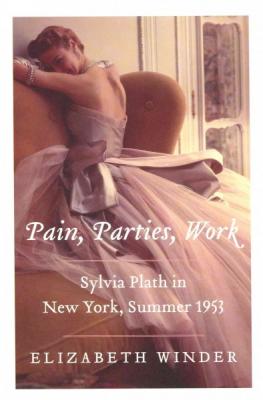
Pain, Parties, Work by Elizabeth Winder is a compelling look at a young Sylvia Plath and the life-changing month that would lay the groundwork for her seminal novel, The Bell Jar.
In May of 1953, a twenty-one-year-old Plath arrived in New York City, the guest editor of Mademoiselle’s annual College Issue. She lived at the Barbizon Hotel, attended the ballet, went to a Yankee game, and danced at the West Side Tennis Club. She was supposed to be having the time of her life. But what would follow was, in Plath’s words, twenty-six days of pain, parties, and work, that ultimately changed the course of her life.
Thoughtful and illuminating, featuring line drawings and black-and-white photographs, Pain, Parties, Work: Sylvia Plath in New York, Summer 1953 offers well-researched insights as it introduces us to Sylvia Plath—before she became one of the greatest and most influential poets of the twentieth century.
Praise for Pain, Parties, Work: Sylvia Plath in New York, Summer 1953
“Elizabeth Winder has taken Sylvia Plath’s antediluvian summer in New York and given us a pixilated gem of a book. Winder has done nothing less than restore Sylvia to her time—she’s given us the young, brilliant, mischievous girl, and not the ponderous symbol, martyr, or muse. In prose as delightful and lively as the champagne cocktails Sylvia sipped at the St. Regis ball, Winder has made Pain, Parties, Work a prose poem of the senses, and a true account of The Bell Jar before the myth hit the fan.” - Sam Kashner and Nancy Schoenberger, New York Times bestselling authors of Furious Love
“A pixilated gem of a book. . . . In prose as delightful and lively as the champagne Sylvia liked to sip at the St. Regis ball, Winder has made Pain, Parties, Work a prose poem of the senses, and a true account of The Bell Jar.” - Sam Kashner and Nancy Schoenberger, New York Times bestselling authors of Furious Love
“A lovingly detailed inventory, as Technicolor-vivid as a Douglas Sirk film, of the fashions and foods that filled Plath’s summer. Winder convincingly shows that Plath should be recognized as much for her enjoyment of life and her enduring works as for her tragic death.” - Publishers Weekly
“Winder resuscitates a young woman who, while sick, is electrically alive to her first real adventure, running through Manhattan, jumping into cabs with strange men, trawling the racks at Bloomingdale’s and experimenting with cocktails…is captivating…as she struggles with her choices, anxiety, and hope for the future. [Winder] makes a compelling argument that in New York…Plath moved closer to finding the voice that would define her writing.” - Slate
“Will recalibrate your mind and heart. . . . We knew about Plath’s ambition - and angst - but her penchant for flaming-red lipstick and princess heels was a bit of a surprise” - More magazine
“Reading this book sparks feelings of impossible nostalgia for someone who didn’t live through the fifties; in this way, it is an experience akin to watching Mad Men . . . The book is like a little jewelry box of fact-lets. . . . Winder’s Sylvia, young, tan, ‘more California than New York,’ sensitive but biting, literary but wrapped in earthly delight, is delightful to be with.” - Bookslut
“Winder poignantly captures a snapshot of a time that directly inspired one of Plath’s most famous works. She also captures Plath as bright, vivacious . . . For fans, particularly devotees of The Bell Jar.” - Library Journal
“The book offers a new perspective on Plath’s life courtesy of Winder’s exhaustive research.” - Women's Wear Daily
“Winder has painstakingly sketched a fully fleshed out portrait of Plath’s life during that hot, seminal summer, offering a glimpse into the raison d’etre behind Plath’s revered 1963 roman a clef, The Bell Jar. . . . Winder goes into the dizzying, delightful detail.” - USA Today
“An illuminating biography . . . which floods clarifying light on a chapter of the poet’s early life that Plath painted in jaundiced tones in The Bell Jar.” - New York Times, Sunday Styles Feature
“In this accessible, eye-opening new biography, which focuses exclusively on one crucial month of Plath’s life, June 1953, when she traveled to New York City to take up residence at the Barbizon Hotel and work as a guest editor for Mademoiselle magazine, it is the fun loving, Dylan Thomas-stalking, daiquiri-drinking Plath who takes center stage. . . . Winder’s biography reconsiders the familiar portrait, illustrating what makes Plath, for fans of The Bell Jar, ‘as Holden Caulfield is for young men.’” - O Magazine
“The world of ’50s NYC, in all its glamour, is irresistible reading.” - Meg Wolitzer, author of The Interestings